About ManagementPro

ManagementPro helps leaders strengthen high-stakes initiatives before execution begins, and gets initiatives already underway back on sound footing.
Important initiatives often run into trouble before the first task is assigned. People agree on the work without agreeing on the change it must produce. Critical assumptions go untested. Measures track activity without showing whether the initiative is accomplishing its purpose.
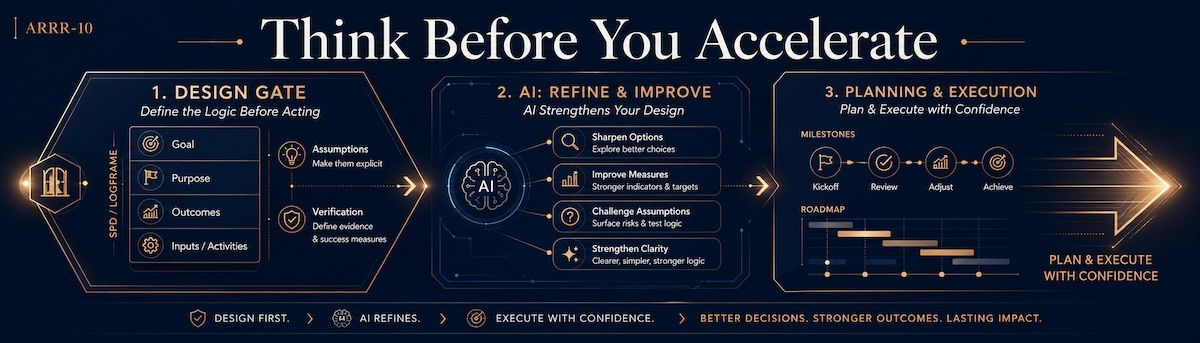
We help leaders and teams find and resolve those weaknesses through Strategic Project Design. At its center is Terry Schmidt's modernized Logical Framework, or LogFrame: a one-page matrix that connects the work, its deliverables, and the intended change with measures of success and the assumptions on which results depend.
Making those connections visible gives teams something concrete to examine together. They can challenge the logic, resolve differences, and strengthen the design before committing major resources.
Who Calls Us, and When
At the Start of Something Consequential
You're launching a strategic priority, cross-functional program, product or system, or legacy modernization with money, credibility, or organizational performance on the line. You need to test the design before major commitments become costly to change.
When Everyone Agrees, Until It's Time to Act
The strategy has approval, but departments disagree about what it means, who must deliver what, and how success will be measured. Initiatives enter planning before those questions are settled. You need a shared design before differences become delays, rework, and missed commitments.
When an Important Initiative Is Stalled or Off Track
Deadlines slip, problems keep resurfacing, and despite the team's best efforts, results aren't improving. Critical decisions remain unresolved. You need to expose weak links in the design and decide what to change, restart, or stop to restore progress.
What Makes Strategic Project Design Different
Strategic Project Design (SPD) is a distinct discipline that comes before planning. It defines an initiative's intended change, outcomes, measures, and assumptions, and it tests the logic connecting effort to results.
SPD builds an executable design using the LogFrame, which expresses an initiative as a cause-and-effect hypothesis. With it, leaders can see whether the activities will produce the deliverables, whether the deliverables will produce the intended purpose, and whether that purpose serves the larger goal. Misalignment, weak assumptions, poor measures, and broken connections become visible early.
Strategic Project Design does not replace traditional project management, it precedes it. It gives Agile, Waterfall, and hybrid methods a more reliable design to work from.
Why It Works
It begins before direction hardens. Most methods start once the goal is set and a plan is due. Strategic Project Design starts earlier, while the initiative can still be reshaped at low cost.
It makes the logic testable. Each level of the LogFrame is an if-then claim. Writing those claims down lets teams challenge them directly instead of debating impressions.
It connects what other approaches treat separately. Strategy, causal logic, assumptions, measures, and execution readiness live in one architecture, so a change in one shows its effect on the others.
It makes rigor simple and actionable. The core tool fits on one page and uses plain language. Teams can apply it in a working session, not after months of training.
It provides a basis for adapting. When conditions change, the design shows which assumptions have broken and which parts of the initiative must change with them.
Enhanced with AI, led by judgment. Leaders and teams draft the design. AI then reviews the draft to challenge assumptions, find gaps, strengthen measures, and stress-test the causal logic. Every decision stays with the leaders accountable for the result.
Who You'll Work With: Terry Schmidt
Terry Schmidt's career has run through engineering, government, international development, business, and the classroom. Each one added a piece of what is now Strategic Project Design.
It started in engineering. As an aerospace engineering student, Terry interned on NASA programs, where he learned to think in systems, causality, and performance under real conditions. He carried that discipline into government, managing federal programs at the U.S. Department of Transportation.
There he was recruited by Practical Concepts Inc., the firm that developed the Logical Framework (LogFrame) for USAID, to field-test and extend the method. That work took him to 24 countries with USAID and the World Bank, designing complex initiatives under political, technical, and institutional uncertainty.
What he saw abroad shaped everything that followed. The problems the LogFrame was built to catch, such as unclear objectives, untested assumptions, and weak links between the work and the results it was meant to produce, were just as common in companies, government agencies, and research organizations. Over the next three decades, he adapted and modernized the method so leaders in those settings could fix these problems before committing to execution.
UCLA Extension's Technical Management Program became his development laboratory. Over more than four decades of teaching short courses there, several thousand technologists and business leaders brought real initiatives into his classroom. Their questions, constraints, and results shaped the method into its current form. UCLA Extension honored him with its Distinguished Instructor Award.
Terry has trained more than 25,000 professionals. His clients include Boeing, Microsoft, Sony, Trader Joe's, and Fernco; the U.S. Department of Energy, and the National Nuclear Security Administration (NNSA); and the Los Alamos, Sandia, and Lawrence Livermore national laboratories.
He holds an MBA from Harvard Business School and a BS in aerospace engineering from the University of Washington. He leads every ManagementPro engagement himself.
Different Challenges. Common Design Problems.
Our clients face a wide range of challenges. A national laboratory needs to align research, operations, and security teams around a major modernization initiative. A manufacturer wants a better process for evaluating and selecting projects before committing resources. A technology company needs product, engineering, and sales teams to agree on what success looks like for a new platform. A federal agency must demonstrate how program spending will produce measurable results.
Despite these differences, the underlying problems are often the same: unclear objectives, conflicting assumptions, weak measures of success, and plans that haven't been tested.
These are design problems, and we help clients solve them before they become execution problems.
For specific examples, see Client Stories →